

In a state where heart disease remains a leading health challenge, an Eastern Kentucky University (EKU) researcher is turning to natural alternatives for affordable, effective treatment.
“At EKU, we are innovating solutions to common concerns in many areas of healthcare,” said EKU President David McFaddin. “Our faculty and our reputable healthcare programs provide qualified graduates for the healthcare workforce and help to improve health outcomes for Kentuckians.”
Kentucky currently ranks 48th in the United States for cardiovascular disease, with nearly 13% of the adult population living with a history of heart attack or stroke, according to America’s Health Rankings. EKU Assistant Professor of Biological Sciences, Dr. Smita Joshi, examines the role of platelets in cardiovascular disease and thrombosis.
“Think of platelets as the body’s ‘first responders’ to an injury,” said Joshi. “When they work correctly, they stop bleeding. When they become hyperactive, they form dangerous clots, called thrombosis, that block blood flow.”
Though some current blood thinners can prevent these clots, Joshi said they can be expensive and still carry a risk of spontaneous, dangerous bleeding. Joshi’s research aims to determine whether compounds found in common dietary sources like ginger and garlic can offer a safer, more affordable alternative without disrupting the body’s natural safety mechanisms.
To achieve this goal, Joshi uses an approach similar to how medicines are identified in the pharmaceutical industry.
“We start at the molecular level, identifying how specific compounds bind to platelet receptors,” she said. “We then move to functional tests, checking combinations where two compounds—like a specific extract from garlic and ginger—work more effectively together than alone.”
Joshi says the impact of this research is twofold, not only making necessary medications more affordable, but also making them safer. By developing blood clot therapies that are natural-product based, patients are given more cost-effective options for long-term preventative care. Additionally, healthcare professionals will have a better understanding of how supplements interact with common blood thinners.
“Our goal is to widen the therapeutic window for thrombosis treatment,” said Joshi. Noting that the line between “preventing a clot” and “causing a bleed” can be dangerously thin, she said, “If we can prove that dietary compounds can achieve this balance, we establish a scientific basis for non-toxic, accessible preventive therapies.”
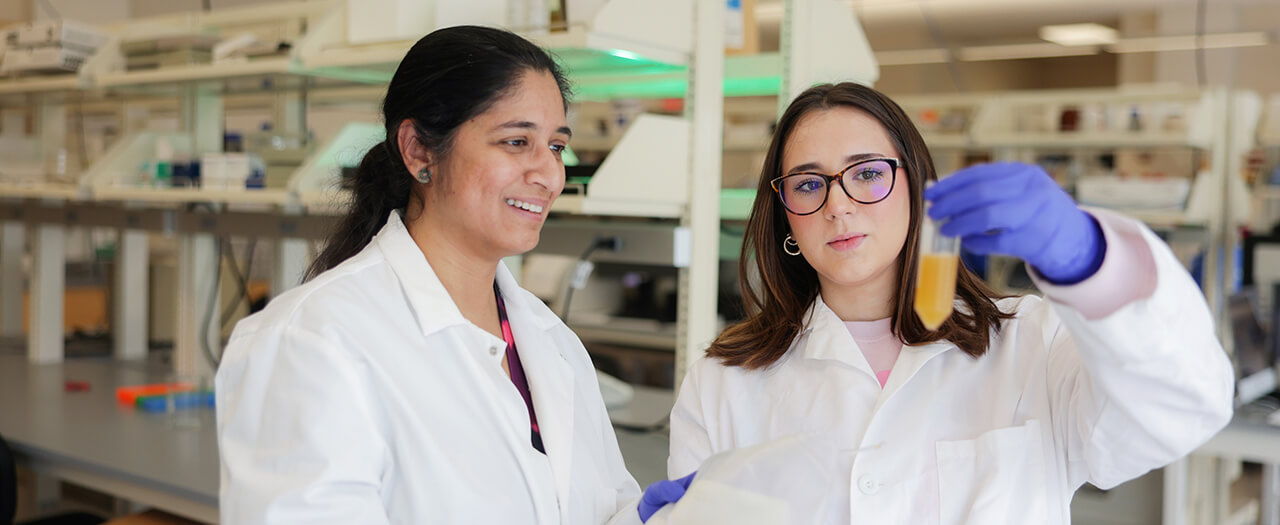
Beyond the clinical potential for the treatment of thrombosis, Joshi’s research also offers immediate benefits for current EKU pre-med students, allowing for hands-on training in a laboratory setting. In her lab, students learn advanced physiology and pharmacology techniques—important skills for future cardiovascular care and research.
“My goal is to build a nurturing research environment where EKU students feel excited to ask questions, take ownership of their projects and contribute to meaningful discoveries,” said Joshi. “I want my students to leave the lab feeling prepared for their future careers in healthcare and science.”
Joshi’s research is supported by the Kentucky IDeA Network of Biomedical Research Excellence (KY-INBRE) and conducted in collaboration with researchers at the University of Kentucky.
By Ethan Sirles
Interested in a degree from EKU?
Earn your undergraduate, graduate or doctoral degree from a university that has been an education leader for more than 100 years. Choose from a variety of in-demand and nationally recognized academic programs, offered both online and on-campus.
Whether you want to start, finish or advance your education, EKU has a program that can fit your schedule and your needs. Complete the form to learn more about how EKU can help advance your career.
Eastern Kentucky University is accredited by the Southern Association of Colleges and Schools Commission on Colleges (SACSCOC) to award associate, baccalaureate, masters, educational specialist, and doctorate degrees.