

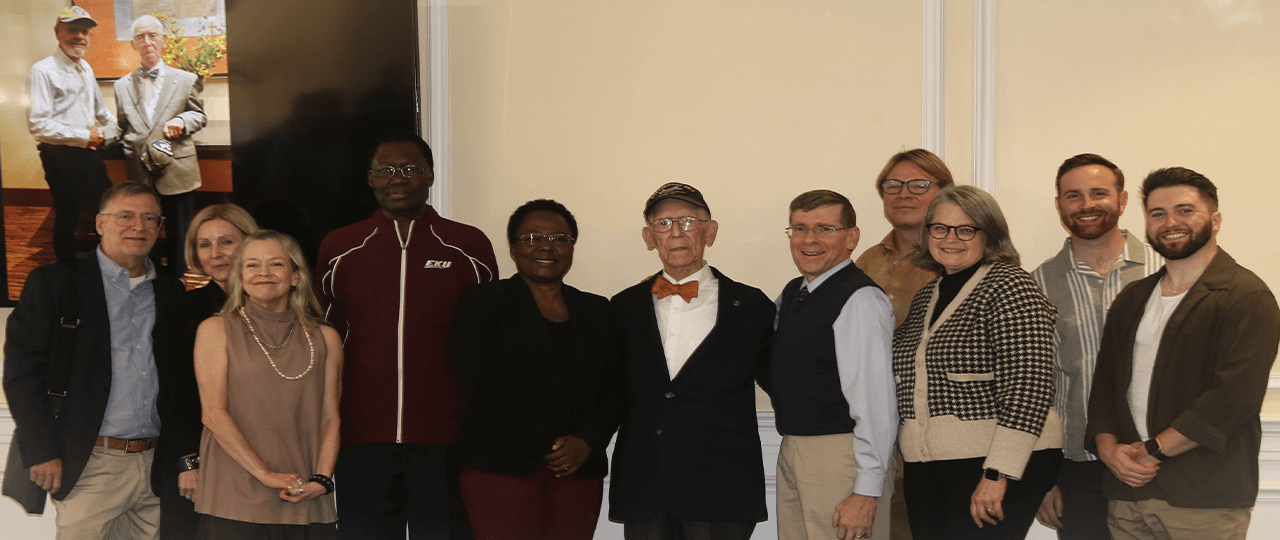
Dr. Sanford Logan Jones Sr. was born in 1925, the son of a coal miner and a teacher. Dr. Jones grew up in Perry County, KY and attended a one-room school. During World War II he served as a Staff Sergeant in the U.S. Army 15th Air Force from 1944-1945. He completed 35 combat missions over Europe as a crew member on a B-24 Liberator bomber and was awarded the Air Medal with three Oak Leaf Clusters.
“I hope to be remembered as a person who was honest and trustworthy. A person of integrity who dealt with others fairly. An educator committed to his students and colleagues. A person dedicated to his wife, June, and his children.”
Upon returning home, he completed high school and obtained a B.S. in Biology and Chemistry (1950), a M.S. in Anatomy and Physiology (1956) and a Ph.D. in Physiology (1960).
He joined Eastern Kentucky University (EKU) as a faculty member in the Department of Biology in 1961 and served the institution with distinction for 31 years, retiring in 1992.
In April 2020, the College of Science at EKU honored the enduring legacy of Dr. Jones — whose decades of dedication profoundly shaped the lives of countless students — by naming him an Iconic Professor. As a lasting tribute, a prominent space within the Science building now bears his name, ensuring his influence continues to inspire future generations.
Dr. Jones turned 100-years old in September 2025. The centenarian remains actively engaged with the College of Science, Technology, Engineering, and Mathematics (CSTEM) by participating in its activities such as the annual retired faculty dinner and through philanthropic support.
According to U.S. Department of Veterans Affairs statistics, 45,418 (less than 0.5%) of the 16.4 million Americans who served in World War II are alive as of 2025. This makes interviewing a 100-year-old WWII veteran and retired university professor a rare and meaningful opportunity. In this article, CSTEM shares Dr. Jones’ responses to questions that honor his life experiences, evoke meaningful stories, preserve personal and historical insights and celebrate his legacy.
CSTEM: How did your military experience shape your life?
Dr. Jones: Shortly after turning 18, in September 1943, I received my draft notice. After training I was assigned to the 15th Army Air Force, 455th Bombardment Group at San Giovanni, Italy, as a nose turret gunner on a B-24 Liberator bomber. From November 16, 1944, to April 18, 1945, our bomber crew completed 35 combat missions over Europe.
Despite the danger that was present, I always believed that I was going to make it home. During my time in the military, I met people from all parts of the country. I was exposed to a diversity of ideas that I had not encountered before. These experiences shaped my thinking as the war was drawing to its end. In 1944 Congress passed what would come to be known as the GI Bill. It provided me with funding to enroll at Eastern Kentucky State Teacher’s College in the fall of 1946. Following graduation in 1950, I became a high school science teacher.
In the summer of 1954, I began work on a master’s degree at the University of Kentucky. During the first week of school, I stopped at a square dance and met June Daugherty. We were married August 18, 1956.
The war years broadened my experiences in many ways. The GI Bill then provided the funding that made it possible to attend college and pursue an academic career.
CSTEM: What is the most significant change you have seen in the education landscape over the course of your life?
Dr. Jones: I would say the way innovations in communication and information transfer have changed the way education is delivered. With just a few clicks, vast quantities of information can be made available. Online courses reach students in remote areas, but in doing so still must find ways to help students interact and connect.
CSTEM: What advice would you give today’s students or educators?
Dr. Jones: Students can learn much from talking to their parents. Hearing from parents about their experiences and what shaped their life goals can help one develop their own path. Volunteer activities, participation in sports and clubs and work experiences, all help define one’s mindset. Educators promote student success by presenting material in a way that students see as relevant and stimulates curiosity, building confidence along the way.
CSTEM: You have lived through so many pivotal moments. Is there any one in particular that deeply impacted you?
Dr. Jones: The awareness of pivotal points is often not recognized when they occur. It takes the passage of time to appreciate their significance. My parents making sure I received more than an elementary school education provided me with a firm foundation. Military service allowed me to meet people from different parts of the country and experience different viewpoints. The GI Bill provided the funding I needed to enroll at Eastern in 1946. My pursuit of additional education led to perhaps the most important turning point. While working on my master’s degree at the University of Kentucky, I met my future wife, June Daugherty. In 1961, I accepted a faculty position in the Department of Biology at Eastern Kentucky State Teacher’s College, and good things came our way.
CSTEM: What makes you feel proud when you look back at your life?
Dr. Jones: I am proud of my formative years growing up on Lost Creek, in Perry County, Kentucky. Serving during World War II in the 15th Army Air Force exposed me to a totally new and challenging set of circumstances. The people I met and my experiences during those years motivated me to go to college and beyond. My work as a high school science teacher in Lebanon, Kentucky, and in the Perry County School System was also fulfilling, as was pursuing my master’s and Ph.D. degrees. Meeting June Daugherty, marrying, and raising our three children together brought me a lot of joy. During my 31 years at Eastern, I became a Full Professor in 1967 and served as Chair of the Department of Biological Sciences from 1979 to 1992. In April 2020, I was named an Iconic Professor by Eastern’s College of Science. Having recently celebrated my 100th birthday, I am proud of my military service, my family and my career at Eastern. I am proud of the students I mentored and grateful for the colleagues I worked with.
CSTEM: What is your secret to living a long, meaningful life?
Dr. Jones: How a person manages conflict and stress are important. I prefer to stay calm and try to avoid comments that are negative. Respect the other person’s perspective/opinion and try to seek consensus rather than argument. Genes play a role, along with lifestyle choices. I like the Carter Family song, “Keep on the Sunny Side.”
CSTEM: Looking back, is there anything you would have done differently?
I prefer not to dwell on decisions that may have had negative outcomes, or to second guess things.
CSTEM: How do you hope to be remembered?
Dr. Jones: I hope to be remembered as a person who was honest and trustworthy. A person of integrity who dealt with others fairly. An educator committed to his students and colleagues. A person dedicated to his wife, June, and their children.