

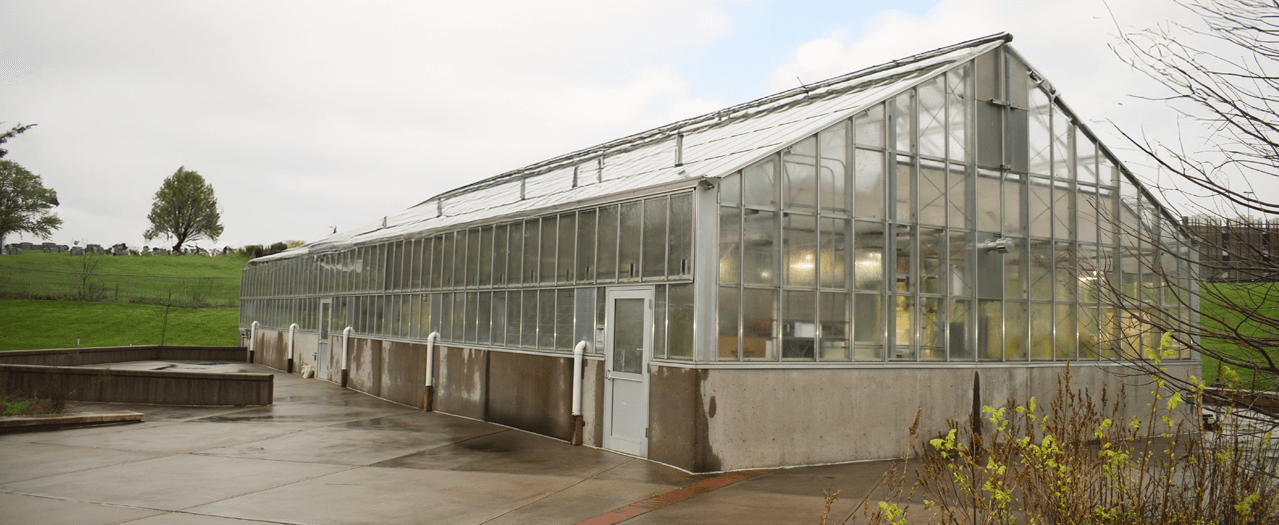
The Department of Biological Sciences’ Greenhouse, located on the campus of Eastern Kentucky University (EKU) by the Science Building, supports the sharing, discovery, inquiry, and excitement in the knowledge of plants. This 3,600 square foot greenhouse was opened in 2018 and features the latest in climate control and automation.
Mr. Robert Pace, a staff member in the Department of Biological Sciences who co-manages the greenhouse explained its physical organization, “The greenhouse is divided into four distinct houses, each of which can simulate different terrestrial environments. The largest house is home to tropical plants and most similar to a tropical dry forest. It is cooler and drier in the winter and hot and humid in the summer. The house that has primarily ferns and orchids mimics a rainforest understory. It is humid year-round and does not receive full sunlight. The arid house contains cacti and succulents. It is sunny and dry year-round, but hot in the summer. In the winter, it is kept cooler to mimic seasonal patterns. The last house is dedicated to teaching, with space allotted for the growing of research plants.”
Although there are automated controls, maintaining the health of plants takes a dedicated team. The greenhouse is co-managed by Mr. Pace and Dr. Jennifer Koslow, an associate professor and plant ecologist in the department who takes the lead on plant care and the living collection. Longer term decisions are made through the use of a Departmental Greenhouse Committee. The vast majority of the day-to-day plant care is done by undergraduate and graduate student workers. Some of our workers are new to working with plants, while others have come to us following excellent training in the EKU Horticulture Program, which is also a part of the College of STEM.
The greenhouse provides opportunities for hands-on learning for several courses in Biology programs, including Cell and Molecular Biology, Genetics, General Botany, Plant Systematics, Molecular Biology, Aquatic and Wetland Plants, and Dendrology. For most of these classes, the greenhouse allows students to encounter plants that are not native to Kentucky in climates that don’t occur in Kentucky either, exposing them to a greater diversity of plant families and forms than they would find locally. It also houses plants of ethnobotanical interest, such as vanilla vine, pineapples, coffee, and citrus.
The most frequent visitors to the greenhouse are students enrolled in General Botany. In a traditional botany curriculum, students often learn about plant anatomy using commercially prepared slides. With access to the greenhouse, students in General Botany at EKU now grow common plants from seeds that they plant at the beginning of the semester and document their natural history throughout the semester. Working with living plants provides the opportunity to directly discover for themselves what they are learning in lecture using living material from plants that they develop connections to.
When asked about the impact that growing and documenting their own plants has had on her students, Dr. Koslow shared some anonymous feedback she had received over the years. “[This project] changed the way I understand the structure and functions of plants and showed me what happens during plant growth from the very beginning, which is a hands-on experience that is unlike anything I have done before.” Another student said, “It helped me see my progress throughout the course. As my plant grew, I continued to use pieces of it for class and learn more about plant morphology/anatomy while being emotionally invested in a garden plant. I was proud of my plant’s progress and my academic progress.”
The greenhouse is also used for community service. As a part of EKU’s close partnership with The American Chestnut Foundation (TACF), American chestnuts or hybrid chestnuts are grown from seeds and returned to TACF for use as demonstration plants and as a part of their breeding program. The American chestnut was once a dominant component of Appalachian forests before a fungal blight arrived on North American shores. The goal of TACF is to restore this species to its original range, so this work is directly connected to our region of Eastern Kentucky.
According to Dr. Koslow, “The greenhouse and the collection that it houses continues to improve with the support of the University, College, and the Department. As we grow, other uses for the greenhouse are being explored. For example, it has been used for experiments during the annual Summer STEM Camp and has been used by the teachers at Model School for tours with their students. This spring it will host an exhibit of art inspired by plants, including many from the greenhouse’s own collection. The artist is a dedicated and knowledgeable greenhouse student worker, Lilia Nichols, who is graduating this spring from the Studio Art Program.”
The greenhouse is not open to the public, but we welcome visitors. If you or your group would like to visit the greenhouse, you can schedule a tour by emailing the Department of Biological Sciences at biology@eku.edu.
Interested in a degree from EKU?
Earn your undergraduate, graduate or doctoral degree from a university that has been an education leader for more than 100 years. Choose from a variety of in-demand and nationally recognized academic programs, offered both online and on-campus.
Whether you want to start, finish or advance your education, EKU has a program that can fit your schedule and your needs. Complete the form to learn more about how EKU can help advance your career.
Eastern Kentucky University is accredited by the Southern Association of Colleges and Schools Commission on Colleges (SACSCOC) to award associate, baccalaureate, masters, educational specialist, and doctorate degrees.