

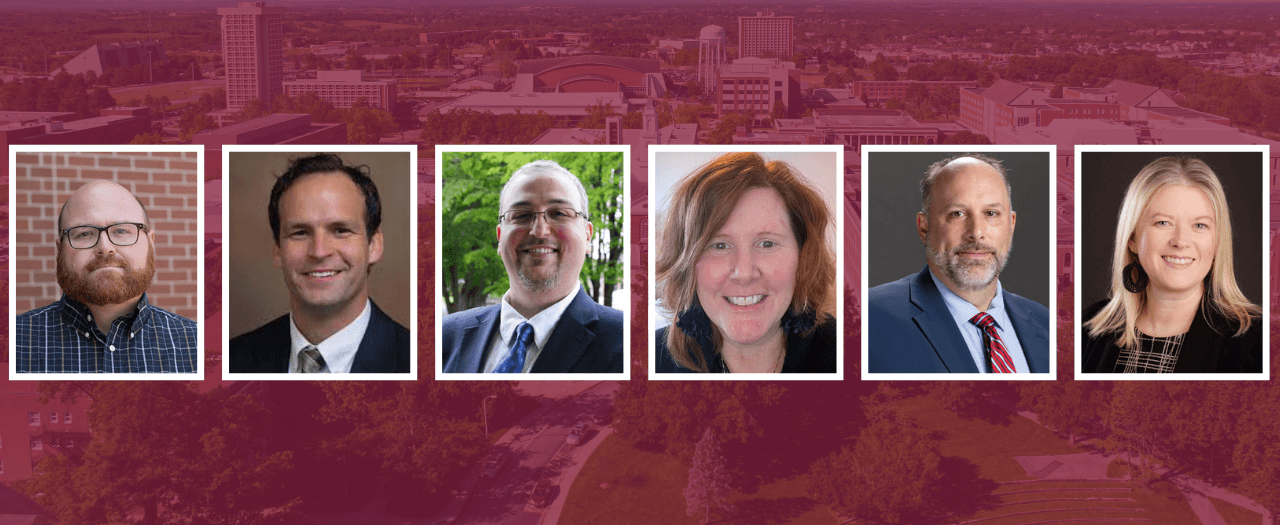
Through a highly competitive process, Eastern Kentucky University (EKU) has selected the cohort for the 2026-27 Provost’s Faculty Internship Program. The program offers faculty participants the opportunity to engage in mentorship and collaboration with Academic Affairs leadership as they gain professional experience with fellow interns.
“This program represents an intentional investment in the growth and development of our faculty,” said EKU President David McFaddin. “With each cohort, we see faculty interns emerge as impactful leaders who are committed to excellence and dedicated to advancing EKU’s mission.”
Provost Sara Zeigler founded the program five years ago with the goal of building exceptional leadership by supporting faculty development.
“The Provost’s Faculty Internship Program is a unique leadership development initiative in Academic Affairs at EKU,” said Zeigler. “I am deeply proud to welcome our 2026-27 cohort to the program, through which dedicated faculty cultivate vital university-wide leadership skills. Through direct collaboration with the Office of the Provost on strategic initiatives, they make tangible contributions to the future of our institution. This tailored individualized leadership development program prepares faculty to lead in the roles they have now or ones to which they aspire.”
Five faculty members and one Provost Fellow were selected for the 2026-27 Provost’s Faculty Internship Program:
Wentzel applied to the program to learn more about the university’s initiatives and how she can lead strategies to help students be successful in and out of the classroom.
“I am interested in exploring ways to better support students beyond their first semester, particularly through the development of life skills that prepare them for success in college and beyond, and the faculty and staff who teach them,” said Wentzel.
Throughout the program, the faculty interns collaborate with deans, associate provosts and Foundation Professors on university-wide initiatives, strategic planning and decision-making.
Among the 2025-26 cohort, Dr. Jill Campbell, associate professor of music education and coordinator of music education, said she had applied to the program to better understand processes in higher education and to contribute to EKU’s overarching goals.
“I recognized that this was a chance to learn from incredible, highly supportive leadership, and I wanted to be part of the learning,” Campbell said.
From her participation in the Provost’s Faculty Internship Program last year, Campbell said, “I learned that people are the greatest resource that we can have around us. It is most important to be able to build a team that has experts in different areas and that the dialogue and work is open and deliberate. People are resourceful, engaged and focused on growth when they feel empowered and valued.”
Campbell has implemented these principles into her teaching of undergraduate and graduate courses, mentorship of student teachers, directing of the treble choir and in her research endeavors at EKU.
The application for the Provost’s Faculty Internship Program opens each spring to associate and full professors. Selected faculty members receive summer compensation to support their participation in the program.
Through opportunities such as the Provost’s Faculty Internship Program, EKU reinforces its role as an Employer of Choice, offering professional development and leadership growth for employees.
By: Olivia Evans
Interested in a degree from EKU?
Earn your undergraduate, graduate or doctoral degree from a nationally recognized university that has been an education leader for more than 100 years. EKU offers a close-knit campus, high-demand degree programs, and flexible learning options, including online and on-campus. From community and opportunity to affordability and career preparation, EKU offers pathways to help every student reach their goals. Complete the form to learn more about how EKU can help you on your career path.
Every Path Made Possible.
Eastern Kentucky University is accredited by the Southern Association of Colleges and Schools Commission on Colleges (SACSCOC) to award associate, baccalaureate, masters, educational specialist, and doctorate degrees.