

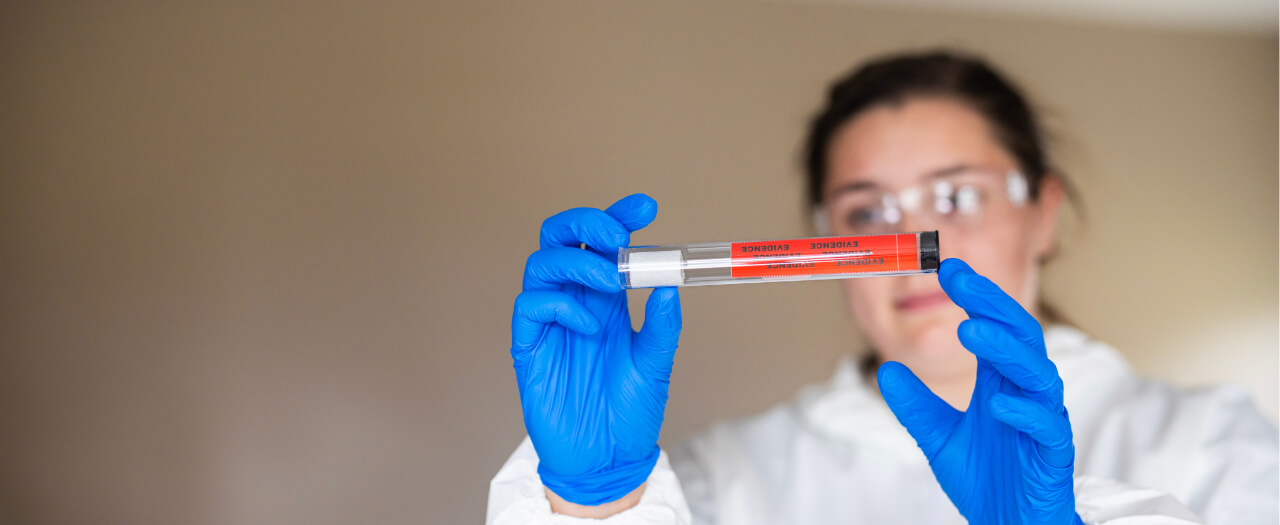
Blood spatter analysis, fingerprint analysis, forensic serology and DNA analysis. While these processes are often shown and discussed in television crime shows, students in Eastern Kentucky University’s (EKU) Forensic Science program put the concepts into practice for real-life crime investigation.
“EKU’s renowned forensic science program is one of the longest-running in the country and the only one in the state to hold accreditation from the American Academy of Forensic Sciences,” said EKU President David McFaddin. “Our top-notch faculty offer students the latest in technology, resources and opportunities, and our graduates have gone on to impressive careers at the FBI and state forensic labs.”
The U.S. Bureau of Labor Statistics expects the demand for forensic science technicians to grow much faster than average at 13% over the next decade.
Bryanna Harmon from Lexington first became interested in the forensics field from true crime shows. Now, as a junior in EKU’s Forensic Science program, she learns and applies forensic techniques in class, fueling her passion for solving crimes.
In the fingerprint analysis class, students dust for prints, develop prints using iodine fuming and learn the science behind each line and spiral.
“Each week is something new, so it keeps it exciting,” said Harmon.
In addition to hands-on learning, students work alongside faculty with extensive experience in forensics. Adjunct Professor Joseph Wallace, a former police officer and investigator, shares actual stories about the topics students are learning and how he has used forensic science in the field.
Dr. Jamie Fredericks, associate professor and director of forensic science at EKU, has developed a DNA collection tool, reducing the time involved with DNA testing, saving resources and reducing contamination risk. Dr. Fredericks received funding from the Kentucky Network for Innovation and Commercialization to continue refining the tool with a goal of bringing it to market.
“I love the fact that forensic science is an applied science. You’re taking the core principles of math, physics, biology and chemistry and applying them to real-life situations to solve crimes,” said Dr. Fredericks.
The Crime Scene House, within a 10-minute walk of EKU’s Science Building, presents mock crime scenes for students to practice processing crime scenes, recover evidence and analyze samples in the lab.
The ForSci Living Learning Community allows students majoring in forensic science to live together in the same residential hall, with opportunities to interact and connect with forensic professionals and faculty. From a monthly Sherlock Seminar Series to forensic lab tours, students get an immersive education that extends to nearly every aspect of their college experience.
EKU’s Bachelor of Science in Forensic Science offers concentrations in forensic biology and forensic chemistry. With EKU’s program accredited by the Forensic Science Education Programs Accreditation Commission (FEPAC) of the American Academy of Forensic Sciences (AAFS), Dr. Fredericks said, “FEPAC is considered the gold standard in forensic science academia.”
EKU graduate Allison Winter said, “I was looking at accredited forensics programs and immediately fell in love with the campus as soon as I took my first steps during the college visit. In just my first visit, they brought me to the Science Building where I got to talk individually with a professor in the degree to ask all my questions and see the labs and classrooms. EKU was the only school that provided this for me.”
EKU is ranked among the top 10 Best Affordable Forensic Science Programs for 2025 by University HQ. EKU’s Forensic Science program offers hands-on experience, expert mentorship and real-world applications to prepare students for an impactful career.
By Christina Rannells
Interested in a degree from EKU?
Earn your undergraduate, graduate or doctoral degree from a university that has been an education leader for more than 100 years. Choose from a variety of in-demand and nationally recognized academic programs, offered both online and on-campus.
Whether you want to start, finish or advance your education, EKU has a program that can fit your schedule and your needs. Complete the form to learn more about how EKU can help advance your career.
Eastern Kentucky University is accredited by the Southern Association of Colleges and Schools Commission on Colleges (SACSCOC) to award associate, baccalaureate, masters, educational specialist, and doctorate degrees.