

Before a swim in a lake or a walk through a creek, few people think about bacteria or toxins from algae. But what lives in that water can affect health days later. At Eastern Kentucky University (EKU), research led by Dr. Jason Marion helps explain the unseen contaminants in waterways and why it matters for public health.
Marion, professor of environmental health science, studies water quality, antibiotic resistance and how people, animals and the environment affect one another. Known as One Health, this approach looks at human health, environmental health and wildlife health as one connected system.
“Our faculty’s passion for their fields, collaboration with students, innovative studies and community impact exemplify excellence in research,” said EKU President David McFaddin. “As we build momentum in research, faculty like Dr. Marion are leading by example in securing funding and several first research awards for EKU.”
Marion has spent 14 years at EKU, originally drawn by the university’s strong environmental health science program and its reputation as a leader in the field. Growing up in Appalachia, he spent most of his time exploring nature and playing in creeks, developing a lifelong curiosity about the outdoors and the ways the environment shapes human health.
“There’s no way of escaping the air that we breathe or the water that we drink,” said Marion. “It’s extraordinarily important because we are inextricably linked to the health of not just our fellow humans around us, but also the environment that we live in.”
Marion’s research focuses on bacteria in the environment and how it affects health. In recreational lakes, Marion tested and measured E. coli bacteria and toxins from algae in the water. The study found some swimming beaches to have E. coli and toxin levels above health guidance standards, as well as a link to higher reported rates of gastrointestinal illness among swimmers.
In Appalachian Kentucky streams, Marion and students look at the prevalence of E. coli and explore how land uses like mining, farming and development impact the types (or strains) that can persist. The research found higher levels of antibiotic-resistant bacteria in disturbed sites, especially after rain, and lower levels in forested areas. Marion’s related studies of wildlife feces and roadkill show how resistant bacteria moves between water, animals and humans.
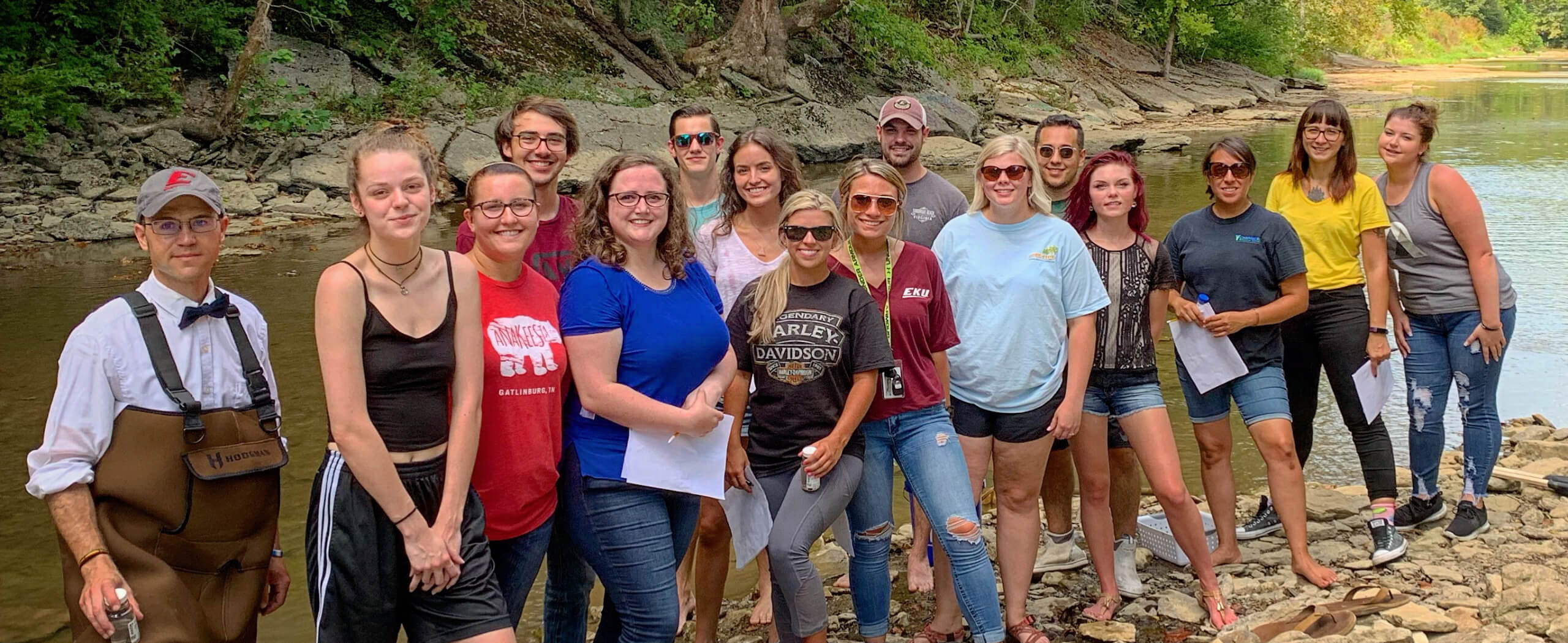
Students play a vital and active role in this research, from collecting water samples in local creeks to analyzing data in the lab.
“We like to provide opportunities for students to be able to learn and have hands-on educational experiences where they can take this knowledge and continue to use it in their professional careers,” said Marion.
Tyler Sullivan, ’24, an EKU graduate from Corbin who earned his bachelor’s degree in environmental health science and sustainability, jumped at the opportunity for an internship with Marion studying E. coli in local waterways. The project took him across Madison County, collecting water samples from streams and small bodies of water, then returning to the lab to conduct tests and document the results.
“We got to get out in nature multiple times every week and explore new sample locations,” said Sullivan. “This process created a ton of memories I’ll have for the rest of my life regarding Dr. Marion, my coworkers and EKU in general. I don’t think I could have asked for a better experience.” Sullivan is now pursuing a master’s in safety, security and emergency management from EKU.
For both Marion and Sullivan, the work goes beyond data and samples. It’s about contributing to the safety and health of the community.
With more than 30 publications to his name, Marion has also led or co-directed externally funded research efforts exceeding $1 million. His funding sources have included the National Institutes of Health and the Centers for Disease Control. Notably, he secured EKU’s first National Science Foundation (NSF) Major Research Instrumentation award in 2023 and EKU’s first Small Business Technology Transfer Research award in 2024 from the U.S. Department of Agriculture. In 2021, Marion received the Global Health Innovation Prize for developing a novel method to quantify E. coli in water.
Last year, Marion was named to the 2025-26 EKU Faculty Research Fellowship program, which supports research growth across campus by promoting funding opportunities, mentoring colleagues and celebrating research.
By: Jake Hall
Interested in a degree from EKU?
Earn your undergraduate, graduate or doctoral degree from a university that has been an education leader for more than 100 years. Choose from a variety of in-demand and nationally recognized academic programs, offered both online and on-campus.
Whether you want to start, finish or advance your education, EKU has a program that can fit your schedule and your needs. Complete the form to learn more about how EKU can help advance your career.
Eastern Kentucky University is accredited by the Southern Association of Colleges and Schools Commission on Colleges (SACSCOC) to award associate, baccalaureate, masters, educational specialist, and doctorate degrees.