

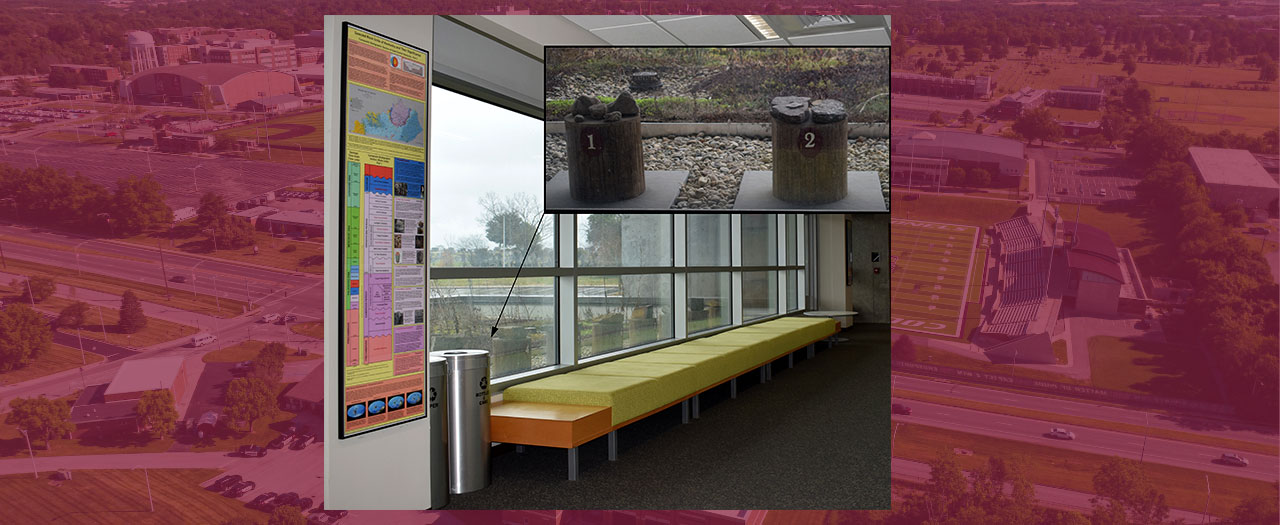
Located at the north end of the Science Building’s second floor lies one of Eastern Kentucky University’s (EKU) quietest educational treasures: a rooftop garden unlike any other on campus. Though it has no formal name and contains no specialized equipment, this open-air display serves as an engaging, hands-on introduction to the geologic story of Kentucky.
The rooftop display features a curated collection of representative rocks from central and eastern Kentucky, arranged from oldest to youngest. Visitors can literally view more than 700 million years of Earth’s dynamic history – beginning with billion-year-old Precambrian rocks and ending with rocks older than 252 million years from the Pennsylvanian Period.
Each rock is paired with a clear, accessible explanation of how it formed. The story of each rock intertwines with Earth’s broader geologic past, especially the Paleozoic Era, the 300-million-year-long chapter during which most of Kentucky’s familiar sedimentary rocks were deposited. Over geologic time, mud became shale, sand was compressed and cemented into sandstone, and lime sediments solidified into the limestone commonly found across the state. Kentucky’s sedimentary rocks, including our samples, also contain fossils, ranging from ancient marine shells and corals to plant remains and even fossilized trees frozen in time.
For many EKU students this look at geology is personal as they grew up in the commonwealth surrounded by roadcuts, cliffs, and parks that expose the very rocks featured on the rooftop. According to Dr. Walter S. Borowski, Professor Emeritus of geology at EKU, “The display helps students understand that rocks in Kentucky do not occur randomly: they follow a predictable order pattern of age and type across the landscape.” Dr. Borowski, who was named EKU Foundation Professor in 2020-2022 and retired from the institution in 2024, played the leading role in the establishment of the rooftop garden, along with Dr. Alice Jones.
A geologic map as part of the rooftop display allows visitors to locate their hometowns and discover the age and composition of the rocks beneath their feet. This can spark curiosity and a deeper appreciation for Kentucky’s natural heritage. Rocks and fossils often captivate children long before they ever consider a career in science. The rooftop garden helps bridge that gap, showing students that their early interests can evolve into fulfilling, well-paid careers in geoscience.
By raising awareness of Kentucky’s geologic framework and the scientific opportunities it represents, the rooftop garden not only enriches general education but also supports EKU’s geoscience majors. It gives them contextual knowledge about key rock units across the Commonwealth—information essential to their studies and future careers.
Geoscience employment opportunities occur in the public and private sectors and encompass map-making, use of global positioning systems (GPS) and other digital data, recognition and mediation of geohazards, protecting water resources both at the surface and within aquifers, understanding and adapting to climate change, and finding and using earth materials (ores, rare earth minerals, coal, natural gas, oil).
“The rooftop geologic display offers a powerful educational experience. It invites students to explore, question, and imagine themselves as part of Earth’s vast story. And in doing so, it strengthens STEM awareness across campus while celebrating the unique geologic character of Kentucky,” said Dr. Jessica Crist, Chair of the Department of Physics, Geosciences, and Astronomy.
When asked about how the garden was used in a classroom setting Dr. Estifanos Haile said, “It is a look at Kentucky’s ancient geologic past. It highlights the Paleozoic Era, which lasted from 540 to 250 million years ago. These rocks are more than just a collection; we use them in our Great Moments in Earth History (GLY 109) classroom. They help us see how Kentucky’s landscape has changed over time. By studying these samples, students learn that Kentucky was once covered by warm, tropical seas. The limestone throughout the Bluegrass Region, rich with fossils, was formed under these seas and later shaped the region into the karst landscape of sinkholes and caves we all know. Later, the environment transitioned into swampy forests that eventually became the source of Kentucky’s coal industry.”
More information about EKU’s programs in environmental and applied geology can be found by visiting: https://www.eku.edu/stem/physics-geosciences-and-astronomy/bs-environmental-and-applied-geology/