

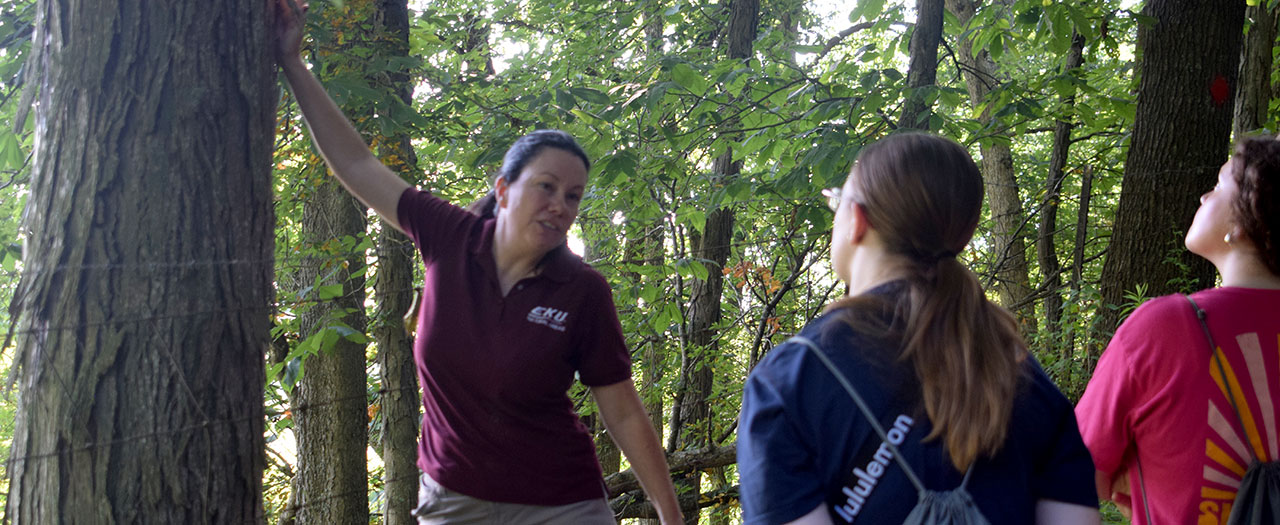
On the south end of the Richmond campus of Eastern Kentucky University (EKU) sits 150 acres dedicated to education, research, conservation, and recreation. The Taylor Fork Ecological Area serves as an outdoor environmental classroom where students can apply what they learn in the classroom to Kentucky’s natural environment. Located at 1 Hancock Taylor Lane in Richmond, Taylor Fork is one of four Natural Areas operated by EKU.
Taylor Fork was established 16 years ago by students and faculty from the EKU Wildlife Society who wanted an outdoor area near campus that could be used for class field trips. With grant funding and hard work, the students and faculty began transforming what had been an abandoned cattle pasture by planting trees, giant cane and wildflowers and installing bird nesting boxes. Their efforts laid the foundation for the wildlife-friendly woodland and prairie habitats now found at Taylor Fork.
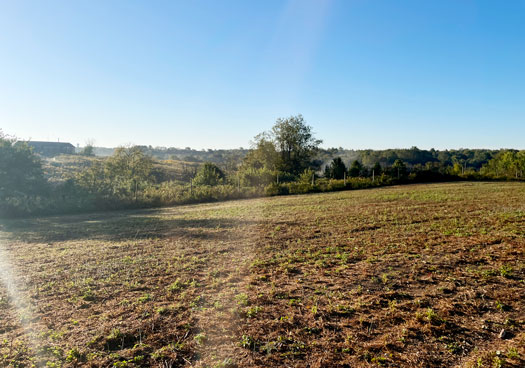
Today, that tradition of student participation continues. According to Dr. David Brown, Professor of Biological Sciences and Interim Director of the Division of Natural Areas, nearly 100 students participated in a restoration project last year that planted 9,500 trees across 25 acres while establishing another 20 acres of pollinator-friendly native wildflowers and grasses. Graduate students assist in the upkeep of the property by completing capstone projects at Taylor Fork, including the development of a natural resources management plan and research monitoring protocol for the area.
“Many people in the conservation community of Kentucky developed land management and restoration experience through working at this site on class projects and as paid student workers on the Natural Areas Resources Crew,” said Brown.
Taylor Fork’s value extends across disciplines. Students from Wildlife Management, Biology, Geosciences, Agriculture, Parks and Recreation Administration and other programs use the property for educational and field-based activities. Division of Natural Areas staff managers Logan Ashley and Jacob Klein provide natural resource training to dozens of students each year through workshops, internships and course-based activities. Students gain experience with land-management practices including prescribed fire, mowing, and invasive plant removal used to maintain early successional wildlife habitat.
The property also serves as a readily accessible research site. Each year, EKU students conduct independent and course-based research at Taylor Fork. Recent projects have compared bat and bird communities at Taylor Fork with those on EKU’s main campus, analyzed 15 years of bird-banding data and examined the status of a giant cane restoration project a decade after planting. Giant cane is one of the very few species of bamboo that is native to North America. It is used at Taylor Fork to out-compete invasive, non-native, plant species.
“Each year, several courses use Taylor Fork Ecological Area as a local field trip destination,” said Dr. Brown. “It’s a great place for field-based studies because instructors and students can conduct experiments that might be more difficult to carry out on other public or private lands.”
The site contains infrastructure that further expands those research opportunities. A weather station managed by Dr. Yow, a Professor of Geography, collects environmental information, while a Motus wildlife tracking station is managed in partnership with the Kentucky Department of Fish and Wildlife Resources. Dr. Cy Mott, a Professor of Biological Sciences, maintains cattle-tank mesocosms at Taylor Fork for amphibian research, and the property is also home to an American Chestnut Foundation Research Orchard.
Taylor Fork’s role, however, extends beyond far EKU students and researchers. Student interns from EKU’s Center for Science and Environmental Education, led by geography professor Dr. Kelly Watson, use the property for K–12 programming and public outreach. Recent activities have included a migratory bird walk, a “night critters” event, and several tree-themed workshops.
The ecological area has also become part of the broader community’s outdoor recreation system. Thousands of visitors use Taylor Fork each year for bird watching, hiking, geocaching, or simply spending time outdoors.
What began as an effort by EKU students and faculty to create a nearby location for field trips has grown into a space where education, research, conservation and community engagement intersect. More than a decade and a half after students helped begin restoring an abandoned cattle pasture, new generations of Colonels continue to shape the landscape while gaining the practical experience needed to become the next generation of scientists and natural resource professionals.