

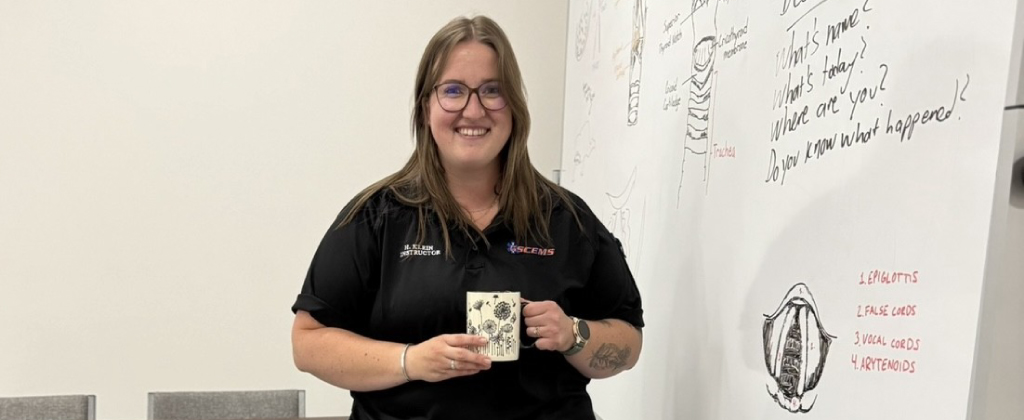
Some stories don’t start with a book deal or a big plan. Some start with grief, frustration, and the quiet weight first responders carry home after shift. That’s where EKU alumnus Hannah Spanyer’s book, The Silence We Carry, began.
Hannah is a critical care paramedic with Georgetown Scott County EMS, where she has served for more than two and a half years. She’s been in EMS for eight years total, nearly six and a half as a paramedic. EMS isn’t just her job — it’s her professional identity, her community, and, at times, the source of the emotional load she writes about.
Alongside her EMS career and writing, Hannah is also completed her paramedic bachelor’s degree through Eastern Kentucky University. As a working paramedic and EMS educator, EKU’s flexibility in education has been key. She credits recorded lectures and understanding faculty for allowing her to balance 24- and 48-hour shifts with coursework. Even general education classes have led her to research topics she never expected, like the legal and ethical complexities of patient refusals in opioid overdose cases — a reminder that learning often shows up in unexpected but valuable ways.
Her book is a collection of poems, but not in the traditional sense. It’s structured like a roundtable discussion among different voices: first responders, family members, coworkers, and even symbolic figures like a grim reaper and a guardian angel. Each voice represents a piece of the emotional landscape surrounding life in emergency services.
What makes the collection powerful is how it came to be. Hannah didn’t set out to write a book. She started writing after the death of a local officer she had known since childhood whose suicide deeply affected her. For Hannah, the loss stirred anger, sadness, and memories of her own past struggles with suicidal thoughts. She is clear that she is not in that space now, but the emotional impact of that loss pushed her to process her feelings the only way she knew how: by writing.
The poems poured out. The first one she wrote now sits in the middle of the collection, with others forming around it from different perspectives. Writing became a safe outlet — a way to release emotion without having to pause life entirely. Like many first responders, Hannah leads a busy schedule filled with shifts, teaching responsibilities, and professional commitments. Being able to jot down a poem in the moment gave her a release valve she could access anytime.
She emphasizes something important: writing didn’t replace therapy. She still believes strongly that first responders should work with mental health professionals. But poetry gave her an immediate tool to name what she was feeling — anger, hurt, exhaustion, grief — and put it somewhere outside herself.
When she shared some poems with trusted friends in the field, their reactions surprised her. They saw themselves in the lines. They encouraged her to publish. With small edits and thoughtful refinements, The Silence We Carry took shape.
Her hope for readers is simple but profound: no one is alone in this profession’s darker moments. The book intentionally avoids narrow labels or identities. It’s written so that any reader — paramedic, firefighter, officer, family member — can find a piece of themselves inside it. It addresses the quiet fear many carry…that being imperfect at work means being imperfect at home, that the mental “noise” in their heads makes them inadequate in every role they hold. Hannah wants readers to know others see that struggle and are fighting alongside them.
Her life reflects something many in EMS talk about but don’t always see clearly: a career in emergency services doesn’t follow a straight ladder. Sometimes you build your own, step by step — clinical work, teaching, leadership roles, continued education, and now authorship.
The Silence We Carry is available in paperback and Kindle formats on Amazon. But more than a book, it’s an invitation — to speak, to listen, and to recognize the shared humanity behind the uniform.
Because in a profession built around responding to others’ crises, sometimes the bravest act is acknowledging your own story — and letting someone else see it. Just like Hanna, EKU Paramedic Degree Program can help your career. Contact Dr. Bill Young at bill.young@eku.edu to see how you can complete your paramedic degree in less time and less cost than you might imagine.
Interested in a degree from EKU?
Earn your undergraduate, graduate or doctoral degree from a university that has been an education leader for more than 100 years. Choose from a variety of in-demand and nationally recognized academic programs, offered both online and on-campus.
Whether you want to start, finish or advance your education, EKU has a program that can fit your schedule and your needs. Complete the form to learn more about how EKU can help advance your career.
Eastern Kentucky University is accredited by the Southern Association of Colleges and Schools Commission on Colleges (SACSCOC) to award associate, baccalaureate, masters, educational specialist, and doctorate degrees.