

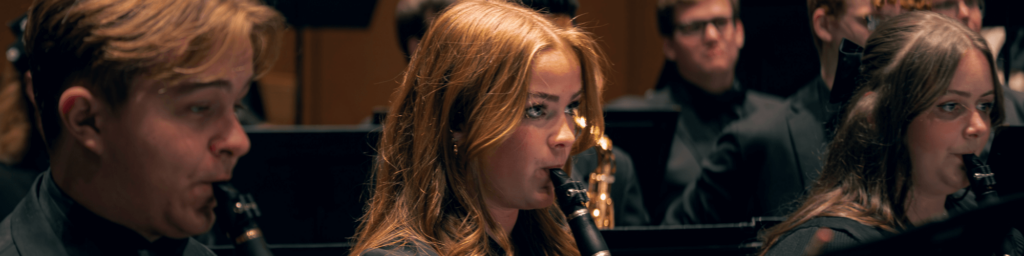
Are you ready for your audition?
Review the requirements for your instrument or voice type below, then schedule your date. Audition days include a Foster Music Building tour, time with EKU faculty and current students, the opportunity to sit in on a large ensemble rehearsal, and a chance for you and your family to ask questions.
Audition Dates
Auditions are by appointment Only!
- Thursday, December, 12 2026 (satellite date)
- Thursday, January 28, 2027
- Thursday, February 18, 2027
- Thursday, February 25, 2027
Students who wish to be considered for scholarships should complete their audition by March 1. Auditions may also be arranged outside the announced dates by emailing music@eku.edu with the subject line “Arrange an Audition.”
Audition Requirements
The following audition requirements are presented in score order, and outline the required scales, selections and technical proficiency required. Please refer to the appropriate section for more detailed information.
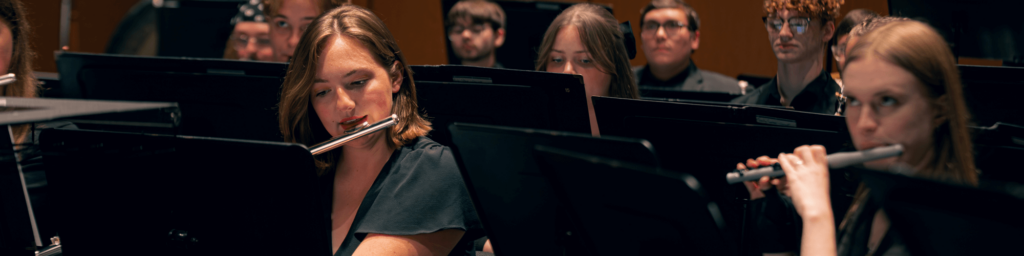
Major scales (at least two octaves). Two selections of contrasting styles, one demonstrating technical facility and one demonstrating tone quality and musicality. Suggested repertoire below; repertoire of equal or greater difficulty may be substituted. Sight-reading.
Recommended repertoire: any All-State or Regional audition pieces; Mozart, Andante in C; Gluck, Dance of the Blessed Spirits; Bach, any sonata; Handel, any sonata; selections from Donald Peck’s 36 Repertoire Pieces for Solo Flute (Schirmer), Cavally’s 24 Short Concert Pieces (Southern), or Flute Music by French Composers (Schirmer).
Contact: Dr. Kristen Kean | kristen.kean@eku.edu
Major scales, at least two octaves up to high D. Two contrasting selections, one fast and technical, one slow and lyrical. Sight-reading.
Recommended repertoire: movements from Telemann’s Sonata in A minor or Handel’s Sonata in C minor; William Grant Still, Incantation and Dance; Gabriel Grovlez, Sarabande et Allegro; etudes from Gekeler’s Oboe Method Book 2, Ferling’s 48 Famous Studies, or Rubank’s Advanced Method Book 3.
Contact: Dr. Julie Smith | julie.smith@eku.edu
Major scales (at least two octaves). Two contrasting selections, one technical, one demonstrating tone quality and musicality. Sight-reading.
Recommended repertoire: Weber, Concertino; Mozart, Concerto for Clarinet (any movement); Weber, Concerto No. 1 or No. 2 (any movement); concerti by Stamitz; C. Rose etudes (Rose 32); All-State or Regional audition music.
Contact: Dr. Adria Sutherland | adria.sutherland@eku.edu
Major scales up to three flats and three sharps (at least two octaves), plus a two-octave chromatic scale. Two contrasting selections, one technical, one lyrical. Sight-reading.
Suggested repertoire: Vivaldi, concerto (any); Galliard, Sonata; Telemann, Sonata; Weissenborn’s 50 Advanced Studies; Milde, Scale or Concert Studies.
Contact: Prof. Heather Kulengowski | heather.kulengowski@eku.edu
A typical audition includes one or more prepared pieces from the standard repertory, requested scales, sight-reading, and optionally a prepared jazz piece and improvised solo. Auditioning on alto saxophone is not mandatory but is recommended, since lessons are primarily on alto.
Standard repertory examples: Bozza, Aria; Lantier, Sicilienne; Handel/Rascher, Sonata III or XIII; Lawson Lunde, Sonata; Heiden, Sonata; Creston, Sonata; Ferling’s 48 Famous Studies; Gatti/Iasilli’s 35 Melodious Technical Exercises. Kentucky All-State material from the current or recent years is also acceptable.
Scales: major scales through four sharps and four flats plus chromatic scale, from memory, full range of the instrument.
Optional jazz component: a solo, etude, or transcription (examples: Niehaus’s Jazz Conception for Saxophone, Mintzer etude books, the Charlie Parker Omnibook) and/or an improvised solo over a blues or standard progression.
Contact: Dr. Keith Talley | keith.talley@eku.edu | 859-622-1428
Major scales (preferably two octaves). Sight-reading. Prepared solo or two contrasting etudes, technical and lyrical.
Sample solo literature: Barat, Andante et Allegro; Goedicke, Concert Etude; Haydn, Concerto for Trumpet; Hindemith, Sonata for Trumpet; Hummel, Concerto for Trumpet; Ligeti, Mysteries of the Macabre; Ropartz, Andante et Allegro.
Sample etudes: Arban’s Complete Method; Bousquet’s 36 Celebrated Studies; Charlier’s 36 Etudes; Concone’s Lyrical Studies; Getchell’s Second Book of Practical Studies; Vannetelbosch’s Etudes.
Also acceptable: all-state or district tryout music, or a solo used for solo and ensemble festival.
Contact: Dr. Joseph Van Fleet | joseph.vanfleet@eku.edu | 859-948-9374
Major scales. Sight-reading. At least one lyrical and one technical etude from Kopprasch’s Sixty Selected Studies, Maxime-Alphonse’s 200 Etudes Nouvelles (Vol. 2 or 3), Pottag’s Preparatory Melodies to Solo Work, or Shoemaker’s Legato Etudes for French Horn.
Solo literature: one movement from a standard concerto or sonata, such as Mozart’s Horn Concertos 1 through 4, R. Strauss’s Horn Concerto No. 1, F. Strauss’s Concerto Op. 8, or Saint-Saens’s Morceau de Concert. A solo used for solo and ensemble festival is also acceptable. Much of this repertoire is available as a free download.
Contact: Dr. Brad Granville | brad.granville@eku.edu | 859-893-1347
Major scales (preferably two octaves). Sight-reading. Prepared solo or two contrasting etudes, technical and lyrical.
Sample solo literature: Barat, Andante et Allegro; De La Nux, Concert Piece; Galliard, any of the six sonatas; Guilmant, Morceau Symphonique; Ropartz, Andante et Allegro; Rousseau, Concert Piece; Saint-Saens, Cavatine.
Sample technical etudes: Arban’s Complete Method; Blume’s 36 Studies; Bordner’s Practical Studies Books 1 and 2; Kopprasch’s Sixty Selected Studies; Paudert’s 24 Studies; Tyrell’s 40 Progressive Studies.
Sample lyrical etudes: Bordogni/Rochut, Melodious Etudes Book 1; Cimera’s 55 Phrasing Studies; Fink’s Studies in Legato.
Also acceptable: all-state or district tryout music, or a solo used for solo and ensemble festival.
Contact: Dr. Nate Siler | nathan.siler@eku.edu | 859-622-1429
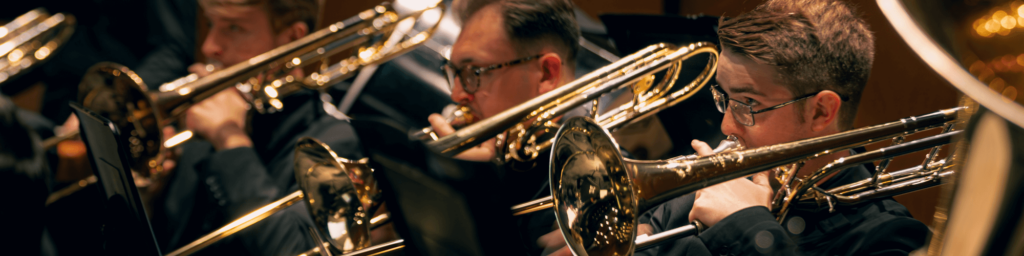
Major scales (at least two octaves). Two contrasting selections, one technical, one demonstrating tone quality and musicality. Sight-reading.
Sample solo literature: Barat, Andante et Allegro; Barat, Introduction and Dance; Galliard, Sonatas; Guilmant, Morceau Symphonique; Handel/arr. Fitzgerald, English Suite; Marcello, Sonatas; Ropartz, Andante et Allegro.
Sample etudes: Arban’s Complete Method for Trombone or Baritone; Blazhevich’s 70 Studies for Tuba (Books 1 and 2); Blume’s 36 Studies; Bordner’s Practical Studies Books 1 and 2; Bordogni/Rochut, Melodious Etudes Book 1; Getchell’s Practical Studies for Tuba Books 1 and 2; Kopprasch’s Sixty Selected Studies; Paudert’s 24 Studies; Tyrell’s 40 Progressive Studies.
Also acceptable: all-state or district tryout music, or a solo used for solo and ensemble festival.
Contact: Prof. Kelly Diamond | kelly.diamond@eku.edu | 859-626-5178
Major scales (preferably two octaves). Sight-reading. Prepared solo or two contrasting etudes.
Sample solo literature: Bach/arr. Bell, Air and Bouree; Barat, Introduction and Dance; Galliard, Sonatas; Haddad, Suite for Tuba; Marcello, Sonatas; Vaughan Williams, Six Studies in English Folksong; Wilder, Suite No. 1 for Tuba. Tubists may substitute any version of the Bordogni Vocalises.
Sample etudes: Arban’s Complete Method; Blazhevich’s 70 Studies for Tuba; Blume’s 36 Studies; Bordner’s Practical Studies Books 1 and 2; Bordogni/Rochut, Melodious Etudes; Kopprasch’s Sixty Selected Studies; Paudert’s 24 Studies; Tyrell’s 40 Progressive Studies.
Also acceptable: all-state or district tryout music, or a solo used for solo and ensemble festival.
Contact: Prof. Kelly Diamond | kelly.diamond@eku.edu | 859-626-5178
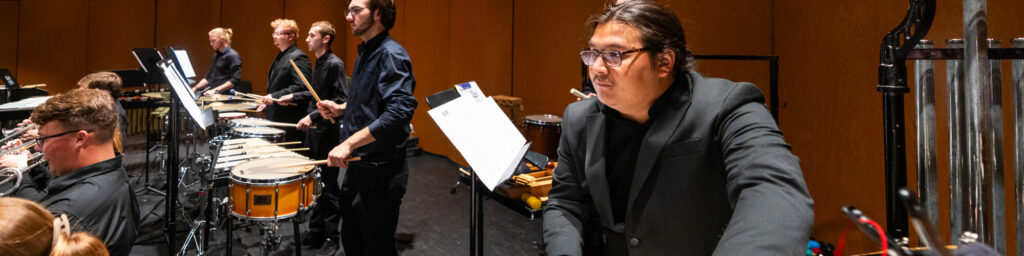
Snare drum: one solo or etude from Delecluse, Albright, Cirone, Peters, Goldenberg, or equivalent.
Marimba: four-mallet solo, one movement or solo/etude from Stout, Abe, J.S. Bach, Creston, Musser, Rosauro, or equivalent.
Timpani: a short solo or etude on three to four timpani (Carter, Goodman, Vic Firth, Peters, Delecluse, Schinstine, or equivalent).
Drum set: demonstrate basic skills in jazz, rock, and Latin styles, with an emphasis on time and feel.
World percussion: demonstrate basic skills on the world percussion instrument of your choice (conga, timbales, djembe, dumbek, etc.), with an emphasis on time and feel.
Contact: Dr. Jason Koontz | jason.koontz@eku.edu
Major scales, two octaves. Two contrasting selections, one demonstrating technical facility and one demonstrating tone quality and musicality, from the standard solo repertoire. Sight-reading.
Contact: Dr. Sila Darville | sila.darville@eku.edu
Major scales, two octaves. Two contrasting selections, one demonstrating technical facility and one demonstrating tone quality and musicality, from the standard solo repertoire. Sight-reading.
Contact: Dr. Sila Darville | sila.darville@eku.edu
Two contrasting pieces demonstrating technique and musicianship, from the standard solo repertoire. A major and a minor scale, at least two octaves. Sight-reading.
Contact: Dr. Nathan Jasinski | nathan.jasinski@eku.edu
Major scales, two octaves. Two contrasting selections, one demonstrating technical facility and one demonstrating musicality, from the standard solo repertoire. Sight-reading.
Contact: Prof. Paul Reich | paul.reich@eku.edu
Classical Guitar: two works from the standard repertoire, from different style periods with contrasting tempos. Suggested composers include J.S. Bach, Francisco Tarrega, Leo Brouwer, Fernando Sor, Mauro Giuliani, John Dowland, and Andrew York. Fingerstyle sight-reading in the first three positions. Two- and three-octave major and minor scales.
Contemporary Guitar, Jazz: two contrasting jazz standards, playing the head, comping the changes, and improvising over the changes. Suggested styles include Swing, Latin, Blues, and Bebop; suggested songs include Autumn Leaves, All the Things You Are, Girl from Ipanema, Satin Doll, Blue Bossa, or similar Real Book selections.
Contemporary Guitar, Contemporary: any contemporary work of your choosing, pickstyle, fingerstyle, pop, jazz, blues, or an original composition.
Contact: Dr. Dennis Davis | dennis.davis@eku.edu | 859-622-5007
Two contrasting pieces originally written for piano, from the Baroque, Classical, Romantic, 20th Century, or Impressionistic eras. All pieces memorized. Approximately 10 to 15 minutes of music. Four major and four harmonic minor scales and arpeggios, hands together, at least two octaves, parallel motion. Sight-reading.
Contact: Prof. Rachel Taylor | rachel.taylor@eku.edu and Dr. Bernardo Scarambone | bernardo.scarambone@eku.edu
Voice majors sing two pieces of contrasting styles. Performance and Music Education majors sing both pieces from memory, with one in a foreign language. Music Industry majors perform one piece from memory, with both encouraged, and a foreign language piece recommended. Art songs and arias are preferred; choral parts, pop, rock, and country selections are not appropriate for the audition. Sight-reading and tonal memory exercises.
Voice minors sing one piece.
An accompanist is provided for all voice auditions. Students using the EKU accompanist must provide a copy of their music in advance; rehearsal time is not available, and recorded accompaniments are not permitted. Dr. Richard Waters, Director of Choral Activities, coordinates auditions for the voice area; contact him with scheduling or accompanist questions at richard.waters@eku.edu.
Contact: Dr. Joyce Wolf | joyce.wolf@eku.edu, Prof. Sherri Phelps | sherri.phelps@eku.edu, Prof. Daniel Koehn | daniel.koehn@eku.edu, and Dr. Christopher Burchett | christopher.burchett@eku.edu
Audition FAQs
It’s easy! All applicants that mark they would like to be considered for a scholarship on the school of music application, are received by March 1 and have auditioned by March 1 will be considered for a scholarship.
There may be several faculty members present at your audition, the number may vary. These faculty members will be familiar with your instrument and upon a successful completion of your audition, some will be your future instructors.
Each instrument has different requirements that are found above. Please prepare for the audition using these requirements as a guide.
Please bring any materials you need for your performance, including music for an accompanist, if needed. Please specify your accompaniment needs on your application form and be sure to prepare the specific audition requirements for your applied area (instrument or voice). Additionally, please wear a mask while visiting EKU and if you have a performance mask (silted instrument mask) please bring it as well if needed for your instrument.
Directly across from the Foster building on Crabbe St. is a pay lot with an app where you can park. Alternatively, you can request a visitors parking permit. Visitor parking is limited, and only allowed in marked locations. There is a fee for a visitors parking permit. Get more information about all these options on the Parking page.
Scholarship determinations are made in multiple rounds. Results from the first round will be released March 15, and results from the final round will be released June 1. You may receive notice of an awarded scholarship any time between those dates.
Large Ensemble Membership
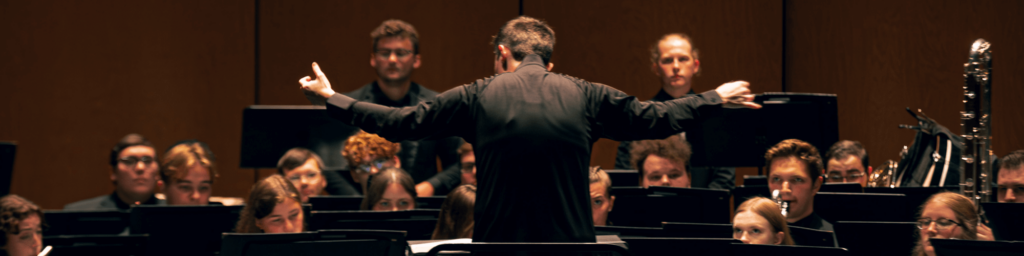
Membership in a large ensemble is separate from admission to the School of Music. Once enrolled, students audition for individual ensembles directly.
Wind Ensemble and Concert Band: EKU Bands page.
University Singers, EnChor, and Koros: EKU Choirs page.
Symphony Orchestra: Contact Jeremy Mulholland, Interim Director of Orchestras.
Theory and Piano Placement
All incoming students complete a notation, theory, and history diagnostic during their School of Music audition visit, used to confirm appropriate placement in coursework. The exam is diagnostic, not pass/fail, but preparing in advance can help you avoid a remedial theory course in your first year.
Students with prior keyboard experience have the opportunity to test out of the class piano requirement. Contact the Piano Sequence Lead, Dr. Bernardo Scarambone, at bernardo.scarambone@eku.edu, to discuss the process.
Applied Faculty
- Dr. Kristen Kean
Flute
kristen.kean@eku.edu - Dr. Julie Smith
Oboe
julie.smith@eku.edu
- Dr. Adria Sutherland
Clarinet
adria.sutherland@eku.edu - Prof. Heather Kulengowski
Bassoon
heather.kulengowski@eku.edu
- Dr. Keith Talley
Saxophone
keith.talley@eku.edu - Dr. Joseph Van Fleet
Trumpet
joseph.vanfleet@eku.edu - Dr. Brad Granville
Horn
brad.granville@eku.edu - Dr. Nate Siler
Trombone
nathan.siler@eku.edu - Prof. Kelly Diamond
Euphonium and Tuba
kelly.diamond@eku.edu - Dr. Jason Koontz
Percussion
jason.koontz@eku.edu - Dr. Sila Darville
Violin and Viola
sila.darville@eku.edu - Dr. Nathan Jasinski
Cello
nathan.jasinski@eku.edu - Prof. Paul Reich
String Bass
paul.reich@eku.edu - Prof. Rachel Taylor
Piano
rachel.taylor@eku.edu - Dr. Bernardo Scarambone
Piano
bernardo.scarambone@eku.edu - Dr. Dennis Davis
Guitar
dennis.davis@eku.edu - Dr. Joyce Wolf
Voice
joyce.wolf@eku.edu - Prof. Sherri Phelps
Voice
sherri.phelps@eku.edu - Prof. Daniel Koehn
Voice
daniel.koehn@eku.edu - Dr. Christopher Burchett
Voice
christopher.burchett@eku.edu
- Dr. Richard Waters
Voice Area Audition Coordination (DCA), richard.waters@eku.edu
Contact Information
School of Music
Foster Music Building, Room 101
2400 Crabbe Street, Richmond KY 40475
859-622-3266
Music@eku.edu