


Hero Image

Bachelor of Science in Engineering

Department of Engineering & Technology

College of Science, Technology, Engineering & Mathematics

Bachelor of Science in Engineering

Department of Engineering & Technology

College of Science, Technology, Engineering & Mathematics

On-Campus

Program

120 Credit Hours

to Graduate

Full-Time, In-State Tuition

$5,325 per Semester

Low-Cost Textbooks

for All Students

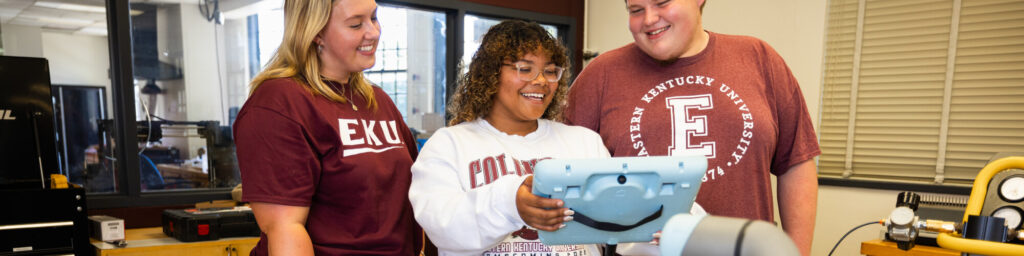
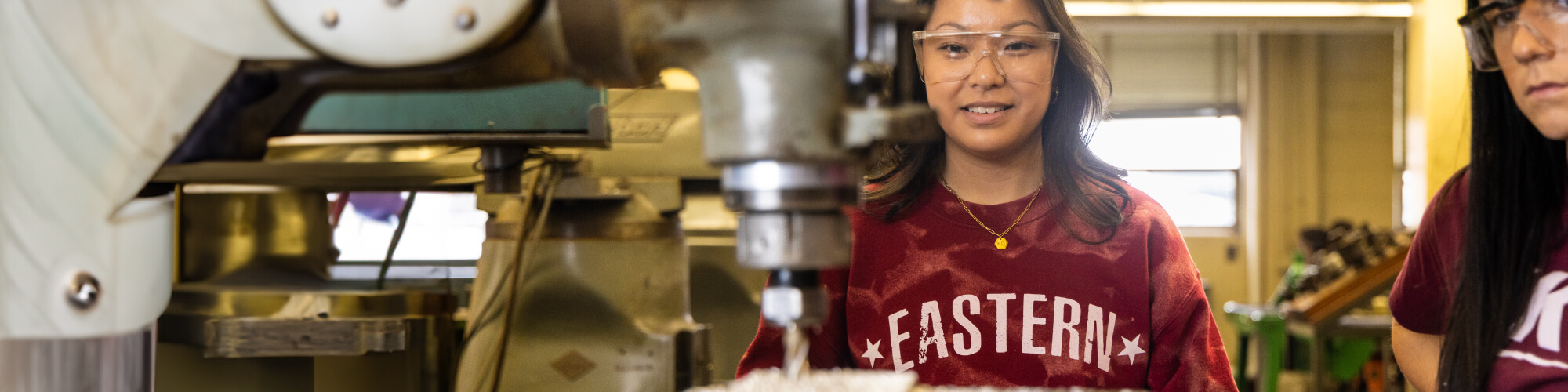
Bring Innovative Products to Life From Start to Finish

Explore new possibilities in prototyping, robotics, and process management

Engineering plays a crucial role in the production of goods and products that are used by people around the world. Engineers are professional problem-solvers. They use math and science, along with skills in critical thinking, to find practical solutions that improve products and processes. Engineers DO things: they design, develop, prototype, fabricate, improve, invent, and make everyday products: from simple items used in the home or office to complex cars, trucks, aerospace products, and aircraft.

Learn More


Loading…

Career Outlook


Industrial engineers focus on reducing internal costs, making their work valuable in manufacturing and other industries, such as consulting and engineering services and research and development firms. As more companies look to lower costs, demand is expected to increase for industrial engineers to optimize production processes, manage supply chains and logistics, and provide expertise on automation.

Within this classification, manufacturing engineers design or improve manufacturing systems or related processes. They may focus on the automated aspects of manufacturing production, upgrades to facility layout, or changes to processes to reduce costs and improve product quality. They also design manufacturing systems to optimize the use of computer networks, robots, and materials.

Employment of industrial engineers is projected to grow 12 percent from 2022 to 2032.

– U.S. Bureau of Labor Statistics

Graduates of the manufacturing engineering program are prepared for professional careers in numerous local, regional, and global industries. These include automotive, aerospace, medical, and technology. Engineering graduates are valued in many other areas as well, due to the emphasis on math, science, and problem solving.

Job Titles Include:

  • Process engineer
  • Production supervisor
  • Automation/robotics engineer
  • Manufacturing supply chain engineer

The Office of Academic and Career Services is a one-stop shop for all your career and professional development needs.

Services Include:

  • Creating/updating your resume and cover letter
  • Interviewing tips and coaching
  • Career documents review
  • Job search

Why EKU?

  • Low-cost textbooks through EKU BookSmart
  • No application fee
  • Reduced tuition for active-duty military members and their spouses
  • Fast-track opportunities for students with 80 or more credit hours
  • Generous credit transfer policy
  • Flexible Engineering degree – a program designed to host multiple, high-demand concentrations
  • Customize your degree with specialized concentrations like Advanced Manufacturing and Quality & Lean Manufacturing
  • Small class size and excellent faculty ensure a supportive and effective learning environment
  • Faculty are experienced as both engineers and educators
  • The Engineering program has significant involvement with local and regional industries in support of the classroom curriculum
  • Internships are highly recommended, receive course credit, and often lead to continued part-time employment with the company

Program Options

Choose between three concentrations that offer the opportunity to tailor the degree to specific career goals and give you a competitive edge in the job market. Options include:

This concentration focuses on how to make complex systems run efficiently. Students learn to organize people, technology, and resources to solve everyday problems, streamline operations, and improve quality across a variety of industries.

This concentration teaches students how to design and build the products we use every day. Students learn the practical skills and technologies needed to turn raw materials into finished goods and improve modern production processes.

This flexible concentration allows students to design a degree around their specific interests. It combines a core engineering foundation with the freedom to select courses from other fields, enabling students to tailor their education to their unique career goals.

Minors & Certificates

Select from a wide range of minors, allowing you to explore interests or make use of prior credits. Suggested minors available for this program include:

  • Mathematics
  • Business
  • Physics

View the full list of minors available.

You can also choose from numerous undergraduate certificates in specialty areas that complement and enhance your major as you work toward your degree. Suggested certificates for this program include:

  • Global Supply Chain Management

View the full list of certificates available for completion as you earn your degree.

Curriculum & Admission


The engineering bachelor’s degree is designed to prepare graduates to become practicing engineers. The program provides students with the skills to design, analyze and modify the processes and systems used to make products in the most time-efficient, cost-effective way possible while maintaining safety and product quality in environmentally friendly ways.

Students will gain expertise and practical knowledge in the major areas of manufacturing materials and processes, design for manufacturability, lean manufacturing, quality and process control, safety, automation and robotics. Graduates will be able to employ a strong base of fundamental engineering and management skills to effectively integrate people, technology, machines and capital to create positive change as they are involved in the manufacturing process from design to production to finished product.

A minimum of 120 credits are required to graduate with a manufacturing engineering bachelor’s degree.

View the degree requirements:

Please review the admissions requirements before applying for this or any program. If you have questions about the program or are planning to register for classes, please speak to the program advisor.

Students may transfer up to 90 hours of credit from accredited institutions. Please note that a minimum of 30 credit hours in this degree program must be completed at Eastern Kentucky University.

Previously earned credits must be reviewed upon admission to EKU for appropriate articulation.

All applicants must provide an application and evidence of appropriate scholastic achievement through prior educational experience.

Please note that certain degree programs have special admission requirements. Admission to the University does not mean automatic admission to all degree programs.

The completed application and all required supporting documentation must be received by the University no later than:

• August 1 for fall enrollment
• December 1 for spring enrollment
• May 1 for summer enrollment

To apply for undergraduate admission to Eastern Kentucky University (EKU), submit an application at apply.eku.edu and submit your materials noted below electronically or by mail to:

Office of Admissions
Eastern Kentucky University
Whitlock Bldg. 112, CPO 54
521 Lancaster Avenue
Richmond, KY 40475-3154.

Note: Students may select Manufacturing Engineering upon applying to the university. Students with a minimum of 27 on the Math subsection of the ACT exam (650 Math SAT) can place directly into calculus. Placement exams and resources are available and encouraged for students not meeting these criteria.

The Bachelor of Science (B.S.) in Engineering degree prepares graduates to become practicing engineers equipped with the fundamental knowledge and skills to address complex challenges across a range of engineering applications. The program emphasizes the application of engineering principles, science, and mathematics to effectively identify, formulate, and solve problems. Students develop the ability to apply engineering design processes to produce innovative solutions and systems that meet specified needs, always considering public health, safety, and welfare, alongside broader global, cultural, social, environmental, and economic factors.
 
Our curriculum fosters core technical competencies, promotes lifelong learning essential for adapting to evolving technological landscapes, and cultivates the ethical and professional responsibilities expected within the engineering profession. Graduates are prepared to contribute meaningfully to their profession and communities through effective communication, collaborative teamwork, and a commitment to ethical practice. The program integrates theoretical knowledge with practical application, preparing graduates to analyze, design, and improve processes and systems effectively. Students will have opportunities to focus their studies in specific areas of engineering practice through elective coursework.

Within a few years of graduation, graduates of the B.S. in engineering program are expected to:

  • Become established practitioners who demonstrate technical independence and assume increasing levels of responsibility in engineering projects within their respective industries.
  • Advance in their careers through continuous learning and successful adaptation to evolving engineering challenges.
  • Contribute effectively and ethically to the engineering profession and their communities.


Upon graduation, students in the B.S. in engineering program will have demonstrated:

  • An ability to identify, formulate, and solve complex engineering problems by applying principles of engineering, science, and mathematics.
  • An ability to apply engineering design to produce solutions that meet specified needs with consideration of public health, safety, and welfare, as well as global, cultural, social, environmental, and economic factors.
  • An ability to communicate effectively with a range of audiences.
  • An ability to recognize ethical and professional responsibilities in engineering situations and make informed judgments, which must consider the impact of engineering solutions in global, economic, environmental, and societal contexts.
  • An ability to function effectively on a team whose members together provide leadership, create a collaborative environment, establish goals, plan tasks, and meet objectives.
  • An ability to develop and conduct appropriate experimentation, analyze and interpret data, and use engineering judgment to draw conclusions.
  • An ability to acquire and apply new knowledge as needed, using appropriate learning strategies.

The constituencies of the B.S. in engineering program are:

  • Program faculty
  • Department of Engineering and Technology Advisory Council

Enrolling & Advising Information


EKU’s College of Science, Technology, Engineering, and Mathematics is committed to delivering high-quality enrollment and academic advising for our students. We strive to create an atmosphere of mutual trust and meaningful engagement to help students reach their academic goals and have a rewarding educational experience.

Interested in enrolling? Reach out to your enrollment advisor.

Professional Headshot of Cory Park

Cory Park

Sr. Counselor, College Enrollment & Career Readiness

Call: 859-622-7959

Text: 859-544-2050

cstem.recruitment@eku.edu

photo of robert munafo

Robert Munafo

Enrollment Advisor

859-622-3101
robert.munafo@eku.edu

Student Stories & Features


  • Hannah Murphy

    EKU Animal and Veterinary Studies Graduate
    I have gained confidence in myself and knowledge through learning for my degree. I wasn’t sure if I was going down the right degree pathway but now I cannot wait to begin a future with the job opportunities my degree will give me!
  • Madeline Bentsen

    EKU Forensic Science Graduate
    The faculty was tough and fair, they wanted me to succeed and they pushed me to think critically and logically. However, they were very understanding and cared deeply for their students. They helped to prepare me for the field of forensics and helped me strengthen my weaknesses.
  • Brad Rich

    EKU Forensic Science Graduate
    The thing that I feel like many people, including myself, find surprising about the program is how encompassing it is. It’s not all chemistry or biology but also public speaking and critical thinking incorporated with mock trial and capstone that truly prepare you for the field of forensic science. After graduating I realized just how well I was prepared by the faculty in my program, making the transition from education to career seamless.

Upcoming Events

Calendars
Venues
Days of the Week
Time of Day
List
Grid
Plain
Sun
16

STEM START

at calendar-day
Mon
17

STEM START

at calendar-day
Tue
18

STEM START

at calendar-day
Wed
19

Big E Welcome 2026

August 19, 2026 – August 23, 2026calendar-multiday
Wed
19

STEM START

at calendar-day
Wed
19

Walkabout Wednesday

at recurcalendar-day

News & Updates

The Vernon C. Wilson Endowed Chair in the Department of Chemistry, Mathematics, Statistics & Computer Science

The Vernon C. Wilson Endowed Chair in the Department of Chemistry, Mathematics, Statistics & Computer Science (the Wilson Endowed Fund) continues to be an important source of support for the Departments of Chemistry & Forensic Science, Computer Science & Information Technology, and Mathematics & Statistics. Through investments in student learning, faculty development, research and infrastructure, […]

Agriculture Senior Sendoff Celebration

Graduation is more than a milestone for the Department of Agriculture at Eastern Kentucky University (EKU), it is a celebration of family, achievement and the lasting bonds formed throughout a student’s journey. Each spring semester, the department honors its graduating seniors for the current spring and upcoming summer and fall semesters through its senior sendoff […]

Student Spotlight: Finn Gosnell

Born in Minnesota, Finn Gosnell spent his early childhood in the upper Midwest before relocating to Kentucky at age nine. He lived in and around the Louisville area until graduating from high school, eventually choosing to continue his academic journey at Eastern Kentucky University (EKU). Eastern’s affordability and strong science programs made it the right […]

Related Programs

B.S. Engineering Technology Management

Common Job Titles: lowercase job title names, lowercase job title names

Modalities: on-campus

Credit Hours: 120

3+2 Dual Degree: B.S. in Engineering Technology Management + M.S. in Technology Management

Common Job Titles: lowercase job title names, lowercase job title names

Modalities: on-campus

Credit Hours: credit hour info here


Contact Information

Department of Engineering & Technology

521 Lancaster Avenue
302 Whalin Technology Complex
Richmond, KY 40475

859-622-3232
engineering@eku.edu